
RESEARCH · DINNERTIME STRESS
The Mental Load of “What’s for Dinner” Is Real — Here’s the Data
The load isn't the cooking. It's deciding, remembering, and coordinating a meal, night after night. A 2026 national survey found parents spend more time planning and preparing dinner than they spend actually eating it together.
By Colton MilbrandtFounder, MindyCart
Updated August 28, 2026
Every number on this page is measured or cited — see how we verify.
The short answer
- A 2026 national survey found parents spend more time planning and preparing dinner than eating it — the burden is structural, not a matter of skill.
- A widely-repeated “89% find dinnertime the most stressful part of the day” statistic misstates its own source; we correct it below.
- Splitting the task more fairly moves who carries it. Removing it — handing the deciding to something that never gets tired — is a different fix.
What the “mental load” of meal planning actually includes
“Mental load” gets used loosely, so it's worth being precise. For dinner specifically, it's not the physical act of cooking — it's the invisible work that happens before a single pan touches the stove: deciding what to make, remembering what's already in the fridge, tracking who's eating and what they won't touch, building the list, and doing all of it again tomorrow. It is, by nature, work nobody sees finished — there's no artifact at the end of deciding, only a plan that has to be made again the next day.
What the research says about dinnertime stress
The most current, directly on-point data comes from the Armour Mealtime Pressure Index, a national survey of 2,000 U.S. parents of children under 18, conducted January 2026 and published by Armour (a Smithfield Foods brand) in June 2026:
- 49%
- of parents say dinner is their most stressful mealtime of the day.
- 39% vs. 23%
- spend the most time planning and preparing dinner, versus only 23% who spend the most time actually sitting down and eating it together.
That second figure is the sharpest evidence that the burden is structural, not a matter of skill: more household time goes into the planning-and-prep step than into the meal itself. The same survey found 57% of parents feel rushed or overwhelmed during busy periods, and 58% say they use meal planning specifically to try to reduce that stress (Armour Mealtime Pressure Index, PRNewswire, June 23, 2026).
A widely-repeated statistic, corrected
What Banza actually found
A separate, older statistic circulates widely in this conversation and is worth correcting here rather than repeating: a commonly quoted claim states that “89% of parents find dinnertime the most stressful part of the day,” often attributed to a Banza survey. That figure misstates its own source. Banza's actual 2021 “Dinnertime Confessions Survey” (conducted by Kelton Global, June 7–14, 2021, n=1,014 U.S. parents) found that 89% of parents say there is at least one thing that causes them stress about dinnertime — not that dinnertime itself is the most stressful part of their day — and separately that 35% of parents find the “what's for dinner?” question specifically stressful. Secondary sources have drifted this into a different, larger claim over time; the number worth citing is the one Banza actually published (PRNewswire, August 4, 2021), or the more current and directly comparable Armour figures above. Full sourcing and correction notes live on our methodology page.
Why “communicate better with your partner” doesn't remove the task
A lot of advice on the mental load of meal planning is about redistributing it more fairly between partners. That's a reasonable thing to want, but it doesn't make the task smaller — it just moves who carries it, and the coordination itself can become its own chore. One person described the pattern exactly: “almost every day, dinner time rolls around and I'll ask if they have any thoughts about dinner. They'll ask me what I want, and then I'll toss it back.” That's decision ping-pong, not decision removal — the deciding still has to happen, it just bounces between two tired people first.
Why decision fatigue makes this worse the more nights in a row you do it
There's a real mechanism behind why this compounds over a week. Decision fatigue — the well-documented tendency for decision quality to degrade as the number of decisions in a day or a stretch of days piles up — is discussed in relation to food choices in a 2026 narrative review (“The Effect of Decision Fatigue on Food Choices,” PMC, 2026), which cites the classic Danziger et al. 2011 finding that even trained professionals' decisions got measurably worse over a decision-heavy day. Dinner isn't one decision — it's five to seven of them a week, every week, indefinitely, which is exactly the kind of repeated load that research says wears judgment down over time.
What actually offloads the mental load
Splitting a chore evenly and removing it are different fixes. Delegating the actual deciding — to someone or something that takes on the planning itself, not just a turn in the rotation — is what removes the task from the household's plate rather than reshuffling it inside the household. That is the gap between an essay that names the problem well and a tool that actually closes it.
How Mindy takes the whole task, not just a piece of it
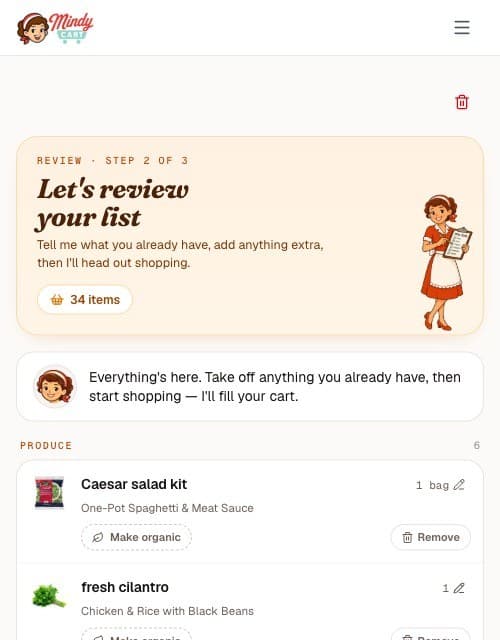
MindyCart exists for exactly this handoff: hand the deciding to someone who never gets tired of it. Mindy plans a full week of dinners from a short chat, remembers what to avoid without being asked twice, and turns the finished plan into a real Walmart cart you review and check out yourself. She doesn't ask a household to split the invisible work more evenly between two tired people — she takes the deciding off the table entirely. If you want to see what a handed-off week looks like end to end, read for people who hate meal planning, or see the actual mechanics on the meal planner that fills your Walmart cart.
Frequently asked questions
Isn't this just a “want,” not a “need”?
The Armour survey's 39%-vs-23% planning-versus-eating time split says otherwise: households are already spending more time on the invisible planning step than on the meal it produces. Removing that time isn't a luxury reframe — it's addressing the actual measured burden.
Does this help if my partner and I already split chores?
Yes — a fair split still means someone (or a rotating someone) has to do the actual deciding each week. Mindy takes on that decision itself, rather than just being whoever's turn it is.
What if I still want to feel involved in what we eat?
You review and approve every meal Mindy proposes before anything is shopped, and you can still edit the consolidated list. Handing off the deciding doesn't mean losing a say in the outcome.
How is this different from a meal-kit subscription?
A meal kit still requires picking meals from its own catalog and ships pre-portioned ingredients at premium per-serving pricing. Mindy plans from what you actually want and fills a Walmart cart at Walmart prices instead of shipping a box.
Related pages
- I hate meal planning — what handing the deciding off actually looks like week to week
- An app that decides dinner for me — why most “decider” apps stop short of the cart
- Meal planner that fills your Walmart cart — the mechanics behind the handoff
- Methodology — how MindyCart sources and corrects the statistics it cites
Colton Milbrandt, Founder of MindyCart
I built MindyCart and run every measured week on it myself. Methodology and editorial policy explain how MindyCart sources, verifies, and dates every number it publishes.